
The 2025 MTS Ministry Partners Conference was held at Scots Presbyterian Church in Sydney from 11–12 November, bringing together leaders from across denominations and ministries.
This annual gathering offers a unique space for encouragement, collaboration, and reflection on how God is forming leaders across Australia. Participants left inspired, challenged, and equipped with practical insights to strengthen gospel partnerships and leadership formation.
Learning from the MTS vision
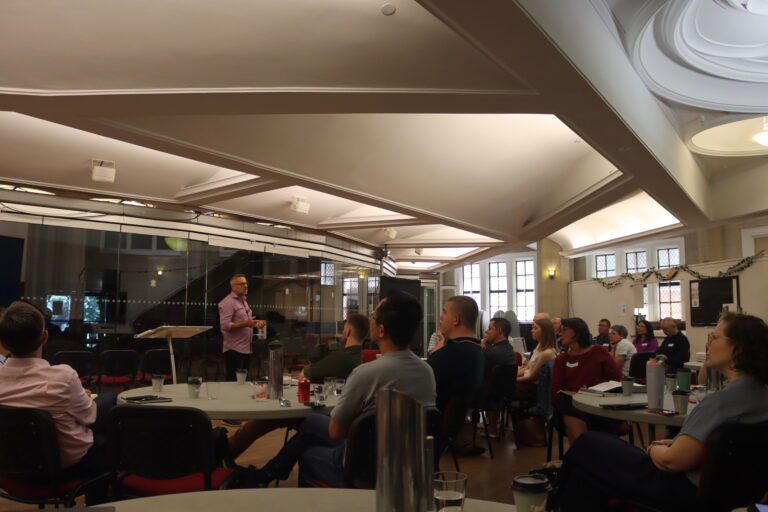
The conference opened with MTS National Director Ben Pfahlert sharing updates on the movement and its strategic direction. Reflecting on a 2024 review, Ben emphasised the importance of understanding who MTS is and the heart behind its mission.
“The vision’s still the same: to win the world for Christ by multiplying gospel workers through ministry apprenticeships. We’re an evangelistic organisation at heart… Our purpose is to grow a movement of Healthy Gospel Ministry Trainers, and our mission is to raise, train, and resource them through formation and fellowship.”
A key focus highlighted by Ben was a shift from investing solely in apprentices to equipping the trainers themselves. “We’ve realised that who we are is that we’re a movement of Healthy Gospel Ministry Trainers, so if we get that right, everything else flows out.”
He introduced the “Three Fs” framework: Formation through structured modules, Fellowship through tables of like-minded leaders, and Framework through pastoral care systems that build trust and accountability.
Ben also shared a SWOT analysis of MTS, reflecting on the movement’s strengths in leadership development, opportunities for multi-generational impact, and challenges such as societal pressures and long-term financial resourcing.
Forming gospel workers
Russ Smidt, MTS Director of Training, led a session on gospel worker formation, sharing insights from his ministry experience over the years. He underscored the need for intentional formation to cultivate healthy gospel workers.
“If apprenticing is a thing in our realm… we need to make sure that formation is healthy, so that… they become healthy gospel workers.”
Russ invited participants to reflect on their own formation, tracing moments of growth, plateau, or decline. Drawing on Richard Rohr and insights from Sally Jones of the Australian Christian Mentors Network, he presented a framework for human formation.
Personal formation and gospel ecosystems
James Hoey, MTS Director of Partnerships, encouraged reflection on personal ministry journeys, highlighting the complexity and non-linearity of formation. Mentorship, honest feedback, formative early experiences, personal faith, Scripture engagement, and a supportive gospel ecosystem all contribute to sustainable growth.
As James noted, “The ecosystem impacts you. The ecosystem impacts those you minister.” Leaders were challenged to consider how they contribute to, or could strengthen, these networks to nurture the next generation of gospel workers.
Stories from around the country
Participants also shared examples of ministry formation in action:
- South Australia: Jack and Kate Hamer showcased Adelaide’s Ministry Apprenticeship Program, which blends centralised training, collaborative pathways, and networking across a small city. Their efforts have led to eight new apprentices starting next year, including more women and church-based placements.
- Victoria & AFES: Dan Kong highlighted the AFES team at Deakin University, where training is embedded into everyday ministry. “Everything that we do in ministry is a training moment… Everyone is always being trained,” he explained. Partnerships with churches and intentional mentorship have led to the development of 23 apprentices over the past decade.
- Ministry to Migrants: Ying Yee shared decades of experience mentoring pastors in Chinese, migrant, and marginalised communities. Emphasising relational, one-to-one ministry, he helps leaders navigate challenges and build resilience, creating pipelines such as BLT/Ignite, Connect, TGCA Asia Network, and Prime Time.
Reflecting and moving forward

Throughout the conference, participants engaged in reflection exercises to identify practical next steps, from sharing insights with their teams to reframing discipleship approaches or setting longer-term goals. Leaders left encouraged by the collaborative energy, the focus on long-term pathways, and the emphasis on supporting youth and women in leadership.
The 2025 MTS Ministry Partners Conference offered a valuable opportunity to reflect, learn, and envision the future of ministry in Australia. By highlighting relational formation, intentional mentorship, and cross-network partnership, the conference demonstrated that ministry is best carried out together—because we’re better together.